
Why Pre-Authorised Codes Are a Strong Approach
Summary: Some think a guard checking IDs beats codes. This article looks at why Aregnum’s pre-authorised codes are a strong security approach.
Some assume that a guard checking IDs at the gate is more secure than a system of visitor codes, picturing the guard’s inspection as the stronger control. The thinking is that a human checking identification catches more than a code does. But pre-authorised codes are a strong approach, because they establish that a visitor is expected and authorised in advance, which is a sounder basis for admission than an ID check at the gate. Understanding this shows why codes are not the weaker option they might seem.
An ID check at the gate verifies identity but not authorisation, which is a limitation. A guard checking an ID confirms who someone is, but not whether they are actually expected or authorised to enter, so the check verifies identity without establishing that the visit is legitimate. Because a code, by contrast, is issued for a specific authorised visit, it establishes that the visitor is expected, which an ID check alone does not.
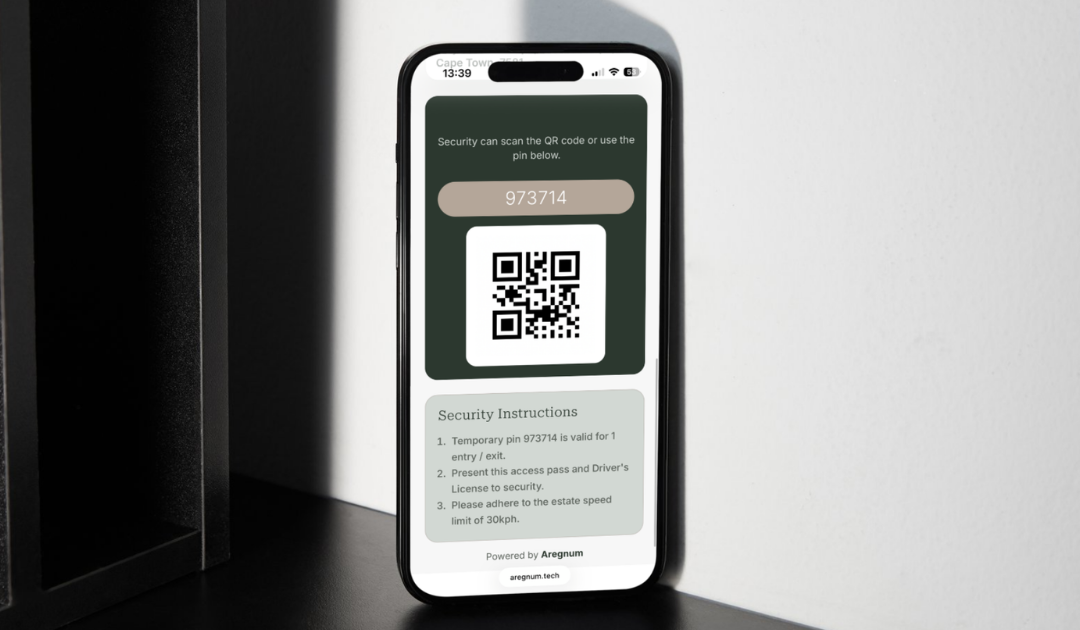
A pre-authorised code establishes that the visit is expected and authorised, which is what admission should rest on. When a visitor arrives with a code, the community knows the visit was arranged and authorised by a host in advance, which is the sound basis for admitting them. Because Aregnum’s codes carry this pre-authorisation, admission rests on the visit being expected and authorised, which is a stronger basis than verifying identity at the gate without knowing whether the visit is legitimate.
Codes tie each visit to a host and a record, which supports accountability an ID check does not. A code is issued by a host for a specific visit and recorded, so each admission is tied to a responsible host and captured in the record. Because the code carries this accountability, the community knows who authorised each visit and has a record of it, which an ID check at the gate, producing no such link, does not provide.
Codes and other controls can work together, so it is not codes versus everything else. Using codes does not preclude other checks where appropriate, and the code provides a strong foundation of pre-authorisation that other measures can build on. Because the code establishes the visit is expected, it strengthens the overall approach, which can still include further checks, so codes enhance security rather than being a weaker substitute for it.
It is worth drawing out that codes also remove the human variability that an ID check depends on, which is a real if less obvious advantage. A guard checking IDs may be tired, distracted, rushed or inconsistent, so the reliability of the check varies with the guard and the moment, whereas a pre-authorised code establishes the visitor’s expected status consistently every time. Because the code carries its pre-authorisation reliably rather than depending on a human inspection that can vary, it provides a consistency that ID checks cannot guarantee, which means codes are not only a sound basis for admission but a more dependable one than a check whose reliability rests on a guard’s attention at a particular moment.
Pre-authorised codes are not less secure than a guard checking IDs; they are a strong approach, because they establish that a visitor is expected and authorised in advance. Aregnum’s codes carry pre-authorisation, tie each visit to a host and a record, and provide a sound basis for admission that an ID check alone does not. For anyone assuming an ID check beats codes, the reality is that pre-authorisation is a stronger foundation than gate verification, so codes are a robust approach to controlling who enters, not a weaker one.
Frequently Asked Questions
Are codes less secure than a guard checking IDs?
No. Pre-authorised codes are a strong approach, because they establish that a visitor is expected and authorised in advance, which is a sounder basis for admission than an ID check at the gate that verifies identity without confirming the visit is legitimate.
What does an ID check miss?
A guard checking an ID confirms who someone is, but not whether they are actually expected or authorised to enter, so it verifies identity without establishing that the visit is legitimate, which a code, issued for a specific authorised visit, does.
How do codes support accountability?
A code is issued by a host for a specific visit and recorded, so each admission is tied to a responsible host and captured in the record, which an ID check at the gate, producing no such link, does not provide.
Can codes work alongside other checks?
Yes. Using codes does not preclude other checks where appropriate, and the code provides a strong foundation of pre-authorisation that other measures can build on, so codes enhance security rather than being a weaker substitute for it.
See Aregnum in action
Ready to turn your community into an effortless, secure haven? Book a demo and we will show you how Aregnum fits your property.