
Moving Beyond Noisy Group Chats and Stale Email Lists
Summary: Informal messaging groups and outdated email lists leave residents uninformed and management uncertain. This article examines how app-based communication tied to verified resident records makes estate communication reliable.
Communication is the connective tissue of any community, and in a residential estate it is also a safety function. Residents need to know about security incidents, water and power interruptions, maintenance work, community events and changes to the rules. Management needs confidence that important messages actually reach the people they are meant for. Yet the channels most estates rely on for this, informal messaging groups and email lists, are surprisingly poor at the job.
Messaging groups are the default in many communities because they are easy to start, but they are a flawed tool for estate communication. They are noisy, mixing genuine announcements with chatter, complaints and off-topic discussion, so important messages are easily buried or scrolled past. They have no reliable record of who has actually seen a notice. They depend on residents choosing to stay in the group, and people mute or leave groups that become tiresome. And they offer no way to target a message to the right audience, so every notice goes to everyone whether it concerns them or not. For an emergency alert, where it matters that the message cuts through, a busy group chat is close to the worst possible channel.
Email lists have the opposite problem. They are quieter, but they go stale. Addresses change, people stop checking the account they signed up with, and the list is rarely kept in step with who actually lives in the estate. Over time the list drifts away from reality, and management cannot be confident that an email to the list reaches the current residents. Like phantom access credentials, a stale contact list is a record that no longer matches the community it is supposed to describe.
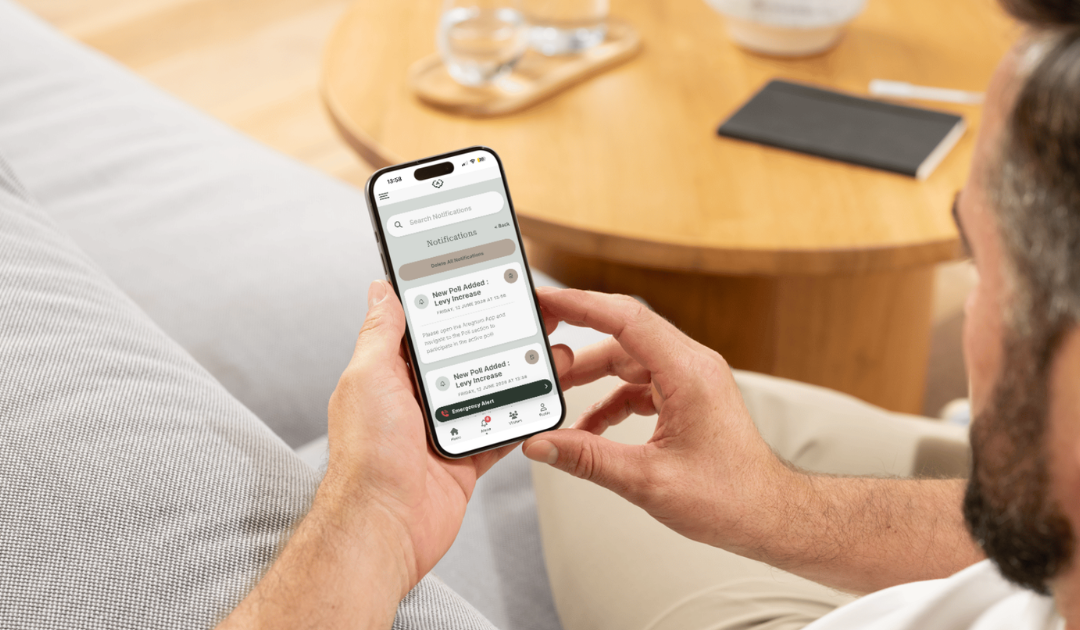
Aregnum approaches estate communication differently by tying it to verified resident records within the community app. When management sends a notice, alert or announcement, it goes to residents through the app, linked to their actual resident profiles rather than to a self-selected group or a drifting email list. Because the same platform manages resident records, the communication audience stays in step with the real community. A resident who is offboarded no longer receives notices, and a new resident is reachable from the moment they are onboarded.
This connection between communication and verified records has several practical consequences. Messages can be targeted appropriately, so a notice about a specific section of the estate goes to the residents it concerns rather than to everyone. Emergency alerts can be sent with confidence that they are reaching current residents on a channel dedicated to estate matters rather than competing with social chatter. And there is a record of what was communicated and when, which protects management if a question later arises about whether residents were informed.
The emergency case deserves particular attention because it is where communication shifts from convenience to safety. When there is a security incident, a fire, a burst water main or any situation that requires residents to act quickly, the estate needs a channel that residents take seriously and that is not drowned in noise. An alert delivered through the community app, distinct from everyday chatter, is far more likely to be seen and acted on. For an estate, having a reliable emergency communication channel is part of its duty of care to residents.
Reliable communication also reduces conflict and rumour, which are corrosive in any community. A great deal of estate friction comes from residents feeling uninformed, hearing things second hand, or believing decisions are being made without their knowledge. When management communicates clearly and reliably through a trusted channel, the space for rumour shrinks. Residents who feel informed are more cooperative and more trusting of the people running the estate, which makes the whole community easier to manage.
There is a workload benefit too. Managing communication across informal channels is fragmented and time-consuming, and it often falls to a volunteer who ends up moderating a group chat in their spare time. Communicating through a structured platform consolidates this into a manageable task, sent once to the right audience with a record kept automatically. The person responsible for estate communication gets their evenings back, and the estate gets more consistent, more professional communication.
It is worth being clear that this does not mean residents lose informal community spaces if they value them. Neighbours can still chat among themselves however they like. What changes is that the estate’s official communication, the notices and alerts that matter for security and operations, runs through a reliable, verified channel rather than competing for attention in a group chat. The official and the informal are separated, which serves both better.
The distinction between reaching residents and merely broadcasting to them is at the heart of why reliable communication matters so much. Broadcasting is sending a message out and hoping it lands. Reaching is sending a message with confidence that it arrives with the intended recipients. Group chats and notice boards broadcast; they put a message out into a space and leave it to chance whether residents encounter it. A channel tied to verified resident records does more than broadcast, because the audience is known and current. This distinction is not pedantic. In an emergency, the difference between broadcasting and reaching can be the difference between residents acting on a warning and never seeing it, which is why the reliability of the channel is a safety matter and not merely a convenience.
Targeted communication, which a verified channel makes possible, solves a problem that undermines communication on undifferentiated channels: notice fatigue. When every message goes to everyone regardless of relevance, residents are bombarded with notices that do not concern them, and they learn to tune the channel out. The resident in one section who repeatedly receives notices about works in a completely different section stops paying attention, and then misses the notice that does concern them. By allowing messages to be targeted to the residents they actually affect, a verified channel keeps communication relevant, and relevant communication is communication residents continue to read. Relevance is what sustains attention, and attention is what makes a channel effective over time.
The record of communication has a governance value that complements its operational value, and it is worth drawing out. Estates make decisions that affect residents, and proper governance requires that residents be informed of those decisions. When communication runs through a platform that keeps a record, the estate can demonstrate that it informed residents of a decision, a rule change or a hazard, which matters if the adequacy of that communication is ever questioned. This protects the board and supports the legitimacy of decisions, because a decision residents were demonstrably informed of stands on firmer ground than one communicated through a channel where it is impossible to show what was sent or seen.
It is worth addressing the concern that moving communication onto a platform might exclude residents who are less comfortable with technology, because a community has a duty to keep everyone informed. This is a fair consideration, and the answer is that a well-run estate thinks about reaching all its residents through whatever combination of means serves them, with the platform as the reliable backbone rather than the sole channel that leaves some residents behind. The point of a verified, app-based channel is to make the estate’s core communication dependable and recorded, which is a large improvement over chats and boards, while the estate remains attentive to ensuring that residents who need alternative arrangements are not forgotten. Reliability for the community as a whole and care for individuals within it are not in conflict.
Reliable communication, in the end, is about trust as much as logistics, because a community that communicates well is a community that trusts its management. When residents know that important information will reach them through a dependable channel, they relax the anxious vigilance and rumour-trading that fills the vacuum where reliable communication is absent. When they see that communication is consistent, relevant and recorded, they extend more trust to the people running the estate. The logistics of reaching every resident reliably and the deeper matter of communal trust are thus bound together: the dependable channel earns the trust, and the trust makes the community easier to run in every other respect. Investing in reliable communication is therefore an investment in the trust on which the whole community depends, not merely in the mechanics of message delivery. An estate that communicates reliably is, in a quiet but real way, demonstrating respect for its residents, treating them as people entitled to be kept properly informed rather than left to glean what they can from noise and rumour. That respect, communicated consistently over time, is itself a foundation of the trust a well-run community depends upon.
For an estate, the ability to reach every resident reliably, every time, is foundational. It underpins security, it supports good governance, and it shapes how residents feel about their community. Moving estate communication onto a platform where it is tied to verified resident records is how an estate gains that reliability, replacing the uncertainty of group chats and stale lists with the confidence that the message got through.
Frequently Asked Questions
How do residents receive communication from Aregnum?
Residents receive notices, alerts and announcements through the community app, tied to their verified resident profiles, rather than through informal group chats or email lists that can go stale.
Can we send messages to only part of the estate?
Yes. Because communication is tied to resident records, notices can be targeted to the relevant residents rather than going to everyone, which is useful for matters that affect only a particular section or group.
Is there a record of what was communicated?
Communicating through the platform keeps a record of what was sent and when, which protects management if a question later arises about whether residents were properly informed.
Does the communication channel work for emergencies?
Yes. Because emergency alerts arrive through the community app on a channel dedicated to estate matters rather than competing with everyday chatter, they are far more likely to be seen and acted on quickly.
See Aregnum in action
Ready to turn your community into an effortless, secure haven?