
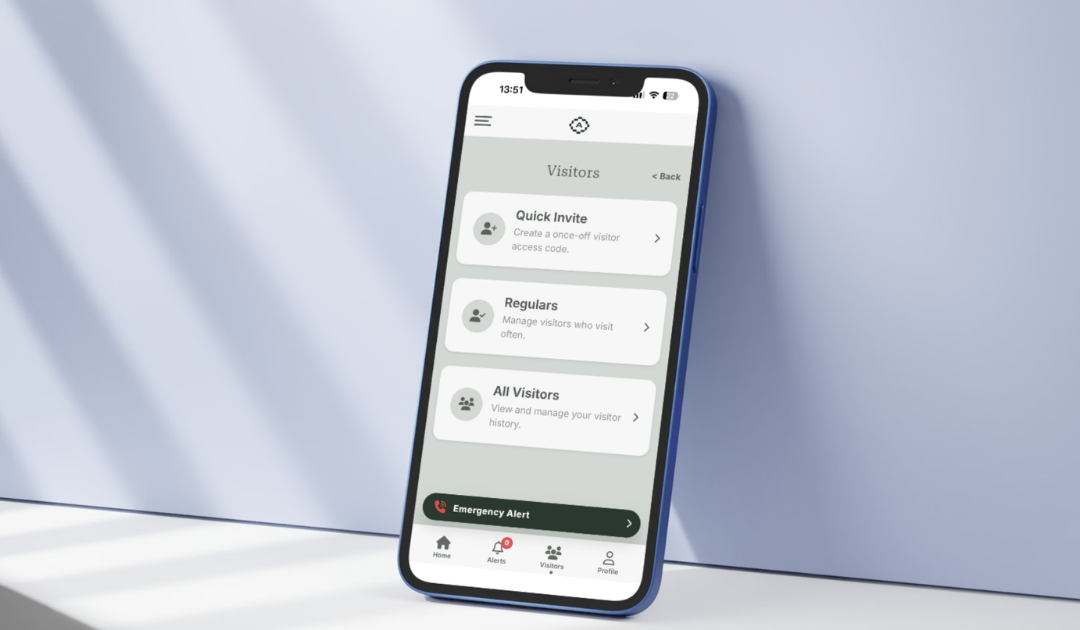
Self-Service Pre-Authorisation That Reduces Reception Bottlenecks
Summary: When every visitor must be cleared through a central reception, delays and bottlenecks follow. This article looks at how letting tenants pre-authorise their own visitors improves flow and frees up management.
In a traditional office park, the management of visitors is centralised. Every visitor arrives at a single point, reception or the gatehouse, and is cleared through whoever is staffing it. That person has to determine whether the visitor is expected, contact the tenant to confirm, and then grant entry. This works after a fashion when visitor volumes are low, but it creates a bottleneck that grows worse as the park gets busier, and it places the management of every tenant’s visitors in the hands of a central point that has no inherent knowledge of who any given tenant is expecting.
The bottleneck is the most visible problem. When several visitors arrive at once, they queue while reception works through them one at a time, contacting tenants to confirm each one. Visitors are delayed, the entrance becomes congested, and the experience reflects poorly on the park. During busy periods, such as a morning when multiple tenants have meetings scheduled, the central clearance model simply cannot keep up, and the entrance becomes a source of frustration rather than a smooth point of arrival.
There is a deeper inefficiency beneath the visible queue. The person at reception has no independent way of knowing whether a visitor is legitimately expected. They have to interrupt the tenant to ask, every time, for every visitor. This is disruptive for the tenant, who is pulled away from their work to confirm a visitor they already knew was coming, and it is slow for the visitor, who waits while the confirmation happens. The central point is acting as a relay for information that the tenant already had, which is inherently wasteful.
Aregnum resolves this by letting tenants pre-authorise their own visitors. A tenant expecting a visitor can authorise that visit in advance, so when the visitor arrives they are already recognised as expected. There is no need to interrupt the tenant to confirm, because the tenant has already provided the confirmation by pre-authorising. The visitor moves through quickly, reception is not bottlenecked working through confirmations, and the tenant is not disturbed. The information about who is expected lives with the person who actually has it, which is the tenant, rather than being requested at the moment of arrival.
This shift, putting visitor control in the hands of tenants, has effects beyond just speed. It gives tenants genuine ownership of their own visitor flow. A tenant who is hosting an important client can ensure that client is recognised and welcomed smoothly rather than left waiting at a confused reception. A tenant expecting a delivery or a contractor can authorise them in advance. The tenant manages their own visitors as part of running their own business, which is appropriate because they are the ones who know their visitor needs.
Crucially, decentralising visitor authorisation does not mean losing oversight, which is the fear that keeps many office parks tied to a central model. Every pre-authorised visit is still recorded, still tied to the tenant who authorised it, and still visible to management on the dashboard. Management sees the full picture of visitor activity across the park, including who authorised whom, even though they are no longer the bottleneck that every visitor has to pass through individually. Control over the record and oversight remains central, while the moment-to-moment authorisation is distributed to the tenants who are best placed to provide it.
This balance is the key insight. The old central model conflated two different things: the authorisation of individual visitors, which tenants are best placed to do, and the oversight of overall visitor activity, which management needs to retain. By separating them, Aregnum lets tenants handle authorisation while management retains oversight. Each function sits with the party best suited to it, which is more efficient than forcing both through a single point.
For office park management, the benefit is a significant reduction in the operational load of handling visitors. Management no longer has to be the relay for every visit, fielding confirmation requests and managing queues. Reception staff, where they exist, can focus on welcoming visitors and handling exceptions rather than processing every routine expected visit. The park runs more smoothly with less central effort, which is especially valuable for managing agents who do not have abundant staff to throw at reception duties.
For tenants, the benefit is a better experience and more control. Their visitors are welcomed smoothly, they are not interrupted to confirm expected arrivals, and they can manage their visitor flow in a way that suits their business. In a competitive market for office space, this kind of smooth, tenant-empowering operation is part of what makes a park attractive to occupy, and it contributes to tenant satisfaction and retention.
The central insight, that authorisation and oversight are different functions best held by different parties, has implications beyond just visitor flow, and it is worth drawing out as a principle. Many management problems arise from putting the wrong function with the wrong party. Centralising authorisation with management puts the decision about whether a specific visitor is expected with the party that has the least knowledge of the answer, which is why it is slow and disruptive. Distributing authorisation to tenants puts the decision with the party that actually knows, while keeping oversight central preserves the visibility management needs. This principle, matching each function to the party best placed to perform it, is a sound way to think about how any shared system should be designed, and visitor flow is a clear illustration of it.
Tenant self-service also scales in a way that central authorisation cannot, which matters as a park grows or gets busier. When all authorisation flows through a central point, that point’s capacity is a hard limit on how many visitors the park can handle smoothly, and as the park grows the central point becomes an ever-tighter bottleneck. When authorisation is distributed to tenants, the capacity grows with the park automatically, because each new tenant brings their own capacity to authorise their own visitors. The system does not develop a worsening bottleneck as it grows, because there is no single point through which everything must pass. This makes tenant self-service not just more efficient at current scale but more sustainable as the park develops.
There is a tenant-satisfaction dimension that connects directly to a park’s commercial success, because tenants who feel in control are more satisfied tenants. A business that can manage its own visitor flow smoothly, ensuring its clients are welcomed well and its deliveries arrive without fuss, experiences the park as enabling its operations rather than obstructing them. A business that has to route every visitor through a slow central process experiences the park as a source of friction. In a competitive market for commercial space, the quality of this experience contributes to whether tenants renew their leases and whether they recommend the park to others. Empowering tenants over their own visitors is therefore not just an operational nicety but a factor in tenant retention and the park’s reputation.
It is important to be clear that distributing authorisation does not mean abandoning rules or control, which is a reasonable concern for management to have. Tenants authorising their own visitors operate within whatever framework the park sets, and management retains oversight of the whole, able to see patterns, identify problems and intervene where necessary. The distribution is of routine authorisation, not of ultimate control, which stays with management. This balance is what makes the model work: tenants get the autonomy to manage their everyday visitor needs, while management retains the oversight and authority to ensure the park as a whole is run properly. Autonomy within a framework, not autonomy without limit, is the principle.
The model that emerges, of tenants authorising and management overseeing, reflects a mature understanding of how a shared commercial property should be run. It neither hoards all control centrally, which creates bottlenecks and disempowers tenants, nor abandons control entirely to tenants, which would forfeit the oversight the property needs. Instead it distributes each function to the party best placed to exercise it, achieving both smooth operation and proper oversight. This balance is what a well-run office park should aspire to across all its functions, and visitor flow is where it is most visibly and immediately beneficial, which is why getting it right here matters so much to how the park operates as a whole. An office park that gets this balance right finds that its visitor flow improves and its administrative load lightens at the same time, because each function has been placed with the party able to perform it most efficiently. That is the practical reward of designing the system around who is best placed to do what, rather than defaulting to a central model that fits no one especially well.
Giving tenants control over their own visitors, while management retains oversight of the whole, is a more efficient and more satisfying way to run an office park’s visitor flow than forcing everything through a central bottleneck. Aregnum is built around this principle, distributing authorisation to the tenants who know their visitors while keeping the record and the oversight where management needs them. The result is a park where visitors flow smoothly, tenants are in control, and management is freed from being the chokepoint that every visit has to pass through.
Frequently Asked Questions
How do tenants pre-authorise their own visitors?
A tenant expecting a visitor authorises that visit in advance through the system, so the visitor is recognised as expected on arrival without reception needing to interrupt the tenant to confirm.
Does letting tenants authorise visitors mean management loses oversight?
No. Every pre-authorised visit is still recorded, tied to the tenant who authorised it, and visible to management on the dashboard. Authorisation is distributed to tenants while oversight of the record stays central.
How does this reduce bottlenecks at reception?
Because expected visitors are already authorised, they move through quickly rather than queuing while reception contacts each tenant to confirm. Reception staff can focus on welcoming visitors and handling exceptions rather than processing every routine visit.
Is this useful for office parks without a staffed reception?
Yes. Pre-authorisation is exactly what makes recorded entry possible at an unmanned entrance, since expected visitors can gain entry through automated access while their visit is still tied to the tenant and recorded.
See Aregnum in action
Ready to turn your community into an effortless, secure haven?