
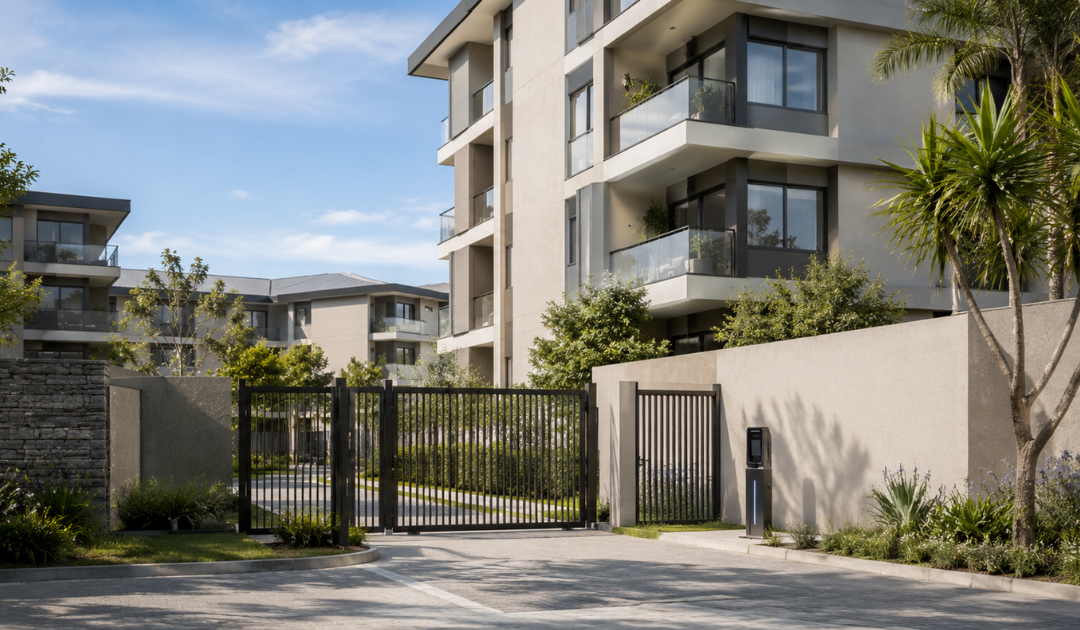
One System That Adapts to Your Security Setup
Summary: Office parks vary widely in their security arrangements, from manned gatehouses to fully unmanned entrances. This article explains how a single visitor management system adapts to both, delivering oversight regardless of staffing.
Office parks come in many forms, and one of the biggest differences between them is how they handle security at the entrance. Some have a staffed gatehouse with security guards checking every vehicle and visitor. Others operate with no guard at all, relying on automated access and self-service entry. Many sit somewhere in between, with guards during business hours and automated access outside them. This variation creates a real challenge for visitor management, because a system that assumes a guard is present is useless at an unmanned entrance, and a system designed for self-service does not support a guard who needs to verify visitors.
Aregnum’s visitor management is built to adapt to both scenarios rather than assuming one. The same underlying system supports an office park with a staffed gatehouse and an office park with no guard at all, which means a managing agent does not have to choose a different product for each property they manage, and an individual office park does not have to replace its system if its security arrangements change. This adaptability is the central design principle, because the reality of office parks is that they do not all look the same and they do not stay the same over time.
In a guarded setup, visitor management supports the guard rather than replacing them. When a visitor arrives, the guard can verify them against pre-authorised visits, capture their details and record their entry in the system. This turns the gatehouse from a place where visitors are logged in a paper register that nobody ever reviews into a point that feeds a proper digital record. The guard’s judgement and physical presence remain, but their work is captured as data that management can actually use, rather than disappearing into a book in the guardhouse.
In an unmanned setup, visitor management does the work that a guard would otherwise do, within the limits of what automation can sensibly handle. Visitors can be pre-authorised by their host, so that expected visitors can gain entry through automated access without a guard physically checking them, while their entry is still recorded. This lets an office park operate without the cost of a guard while retaining a record of who entered and when, which is exactly what an unmanned park otherwise lacks. The absence of a guard does not have to mean the absence of oversight.
The hybrid case, where a park is guarded during the day and unmanned at night, is where a single adaptable system shows its value most clearly. Rather than having one process during staffed hours and no process at all otherwise, the office park runs the same visitor management throughout, with the guard verifying visitors when present and automated pre-authorisation handling entry when they are not. The record is continuous, so management can see the full picture of who entered across the whole day regardless of whether a guard was on duty at the time.
Pre-authorisation is the feature that makes unmanned and after-hours entry workable. When a tenant is expecting a visitor, they can authorise that visit in advance, so the visitor is recognised on arrival rather than being an unknown person at the gate. This is convenient for everyone: the visitor is not held up, the tenant does not have to come to the gate, and the office park has a record tying the visit to the tenant who authorised it. Pre-authorisation effectively lets a tenant vouch for their own visitors in a way the system can act on, which is the key to operating securely without a guard checking each arrival.
Whatever the security setup, the common thread is the record. The fundamental weakness of traditional office park visitor handling is that it produces either no record or a record nobody uses, whether that is an unmanned gate that logs nothing or a paper register that is never reviewed. Aregnum’s visitor management produces a usable digital record in every configuration, so management always knows who entered the park, when, and on whose authority. This record is the foundation of security oversight and it is the thing that manual and fragmented approaches consistently fail to deliver.
For managing agents with a portfolio of office parks, the value of one adaptable system is considerable. They can manage visitor access across guarded, unguarded and hybrid parks through the same platform, with the same dashboard and the same processes, rather than juggling different systems for different properties. This consistency reduces the operational complexity of managing a varied portfolio and means the agent builds expertise in one system rather than several.
It is also worth noting that security arrangements at an office park are not fixed. A park may start with a guard and later move to automated access to reduce costs, or add a guard as it grows and its security needs increase. A visitor management system that only works for one configuration becomes a liability when the configuration changes. A system that adapts means the office park can change its security arrangements without changing its visitor management, which protects the investment in the system and avoids disruption.
The economics of guarding are what drive much of the variation between office parks, and understanding them explains why adaptability matters so much commercially. A staffed gatehouse is a significant ongoing cost, requiring guards across the hours the park is open and often around the clock. For some parks, that cost is justified by the level of activity and the security needs; for others, particularly smaller or quieter parks, continuous guarding is hard to justify financially. Many parks therefore face a genuine tension between security and cost, and the way they resolve it changes over time as their circumstances change. A visitor management system that works whether or not a guard is present lets a park make this cost decision freely, rather than being locked into guarding because its systems cannot function without a guard.
It is worth being precise about what automated, pre-authorised entry can and cannot replace, because overselling it would be a disservice. Pre-authorisation handles the expected visitor well: someone the tenant knew was coming and authorised in advance can be admitted and recorded without a guard. What it does not do is exercise human judgement about an unexpected or suspicious arrival, which is something only a person can do. An unguarded park therefore trades the human judgement of a guard for the lower cost and the convenience of automated expected entry, while retaining the record. This is a reasonable trade for many parks, especially those whose visitors are overwhelmingly expected, but it is a trade, and a park should understand what it is choosing rather than imagining automation replaces a guard entirely.
The hybrid model often turns out to be the most cost-effective arrangement for parks of moderate activity, and a flexible system is what makes it practical. Guarding during business hours, when visitor activity is concentrated and human judgement is most valuable, while relying on automated pre-authorised entry outside those hours, when activity is sparse, aligns the cost of guarding with the times it adds most value. This avoids both the expense of round-the-clock guarding and the exposure of being entirely unguarded. The arrangement only works, however, if the visitor management runs continuously across both modes, which is exactly what an adaptable system provides and a single-mode system cannot. The flexibility of the system is what unlocks the cost efficiency of the hybrid model.
For the property owner behind an office park, the ability to adjust security arrangements without changing systems is a strategic advantage. Owners make decisions about properties over long horizons, during which a park’s tenant mix, activity level and security requirements may all change. A park might be quiet today and busy in three years, or vice versa. Infrastructure that adapts to these changes protects the owner’s investment, because the visitor management does not have to be ripped out and replaced each time the security posture shifts. This durability across change is part of what makes an adaptable platform a sounder long-term choice than a system optimised for the park’s situation at a single moment in time.
The broader principle is that good infrastructure should fit the property rather than forcing the property to fit it, and visitor management is a clear case. Office parks are genuinely varied and genuinely changeable, and a system that demands they all conform to a single model serves them poorly. A system that conforms instead to each park’s actual arrangement, and adapts as that arrangement changes, serves them well across their variety and over time. This is why adaptability is the central virtue here: not as a feature to be admired in the abstract, but as the quality that makes the system actually usable across the real range of office parks and durable across the changes any individual park will go through.
The right way to think about office park visitor management is not as a single fixed process but as a capability that conforms to how each park actually operates. Some parks have guards, some do not, and many change over time. Aregnum’s visitor management is built around that reality, delivering a usable record of visitor access whether a guard is present or not, so that every office park has the oversight it needs in the form that fits how it runs.
Frequently Asked Questions
Does Aregnum’s visitor management require a security guard?
No. The system is built to work both with a staffed gatehouse and at an unmanned entrance. With a guard, it supports their verification of visitors; without one, pre-authorisation lets expected visitors gain entry while their visit is still recorded.
What is visitor pre-authorisation?
Pre-authorisation lets a tenant authorise an expected visitor in advance, so the visitor is recognised on arrival and their entry is tied to the tenant who authorised it. This is what makes secure, recorded entry possible without a guard checking each arrival.
Can it handle a park that is guarded during the day and unmanned at night?
Yes. The same system runs continuously, with the guard verifying visitors when on duty and automated pre-authorisation handling entry otherwise, giving management one continuous record across the whole day.
What if our office park changes its security arrangements later?
Because the system adapts to both guarded and unguarded setups, you can change your security arrangements without changing your visitor management, which protects your investment and avoids disruption.
See Aregnum in action
Ready to turn your community into an effortless, secure haven?