
Beyond the Notice Board and the Building Group Chat
Summary: Apartment buildings rely on notice boards and group chats that fail to reach residents reliably. This article examines how a dedicated communication channel keeps smaller communities properly informed
Communication in an apartment building is deceptively important. Residents share a building, which means they share its problems and its decisions, and keeping everyone informed is essential to the building functioning smoothly. Yet the channels apartment buildings typically rely on, the notice board in the lobby and the building group chat, are poor at the job. They fail to reach residents reliably, they create as much friction as they resolve, and they leave management uncertain whether important information has actually landed. For a small community, where a single uninformed resident can cause disproportionate trouble, this unreliability matters.
The lobby notice board is the oldest tool and the most easily ignored. A notice pinned to a board is only seen by residents who happen to pass it and happen to look, which in practice is a fraction of the building. Residents who use the parking garage and never enter the lobby may never see it at all. There is no way to know who has read a notice and no way to reach anyone urgently. The notice board communicates to the wall more than to the residents, and for anything time-sensitive it is close to useless. It persists because it is cheap and traditional, not because it works.
The building group chat is the modern alternative, and it brings its own well-known problems. Group chats are noisy, mixing genuine building business with chatter, complaints and disputes. Important notices are buried under conversation and easily missed. The chat often becomes a forum for conflict, where disagreements between residents play out publicly and management announcements get tangled up in argument. Some residents mute or leave the chat to escape the noise, and then miss the genuine notices too. The group chat reaches people, but unreliably and at the cost of considerable friction.
Both channels share a fundamental weakness: they are not tied to the actual residents of the building in any reliable way. The notice board reaches whoever passes it. The group chat reaches whoever is in it, which drifts away from the actual resident list over time as people join, leave, change numbers and mute. Neither gives management confidence that a message has reached the current residents of the building, which is the entire point of building communication. Without that reliability, communication becomes a matter of hope rather than a function management can depend on.
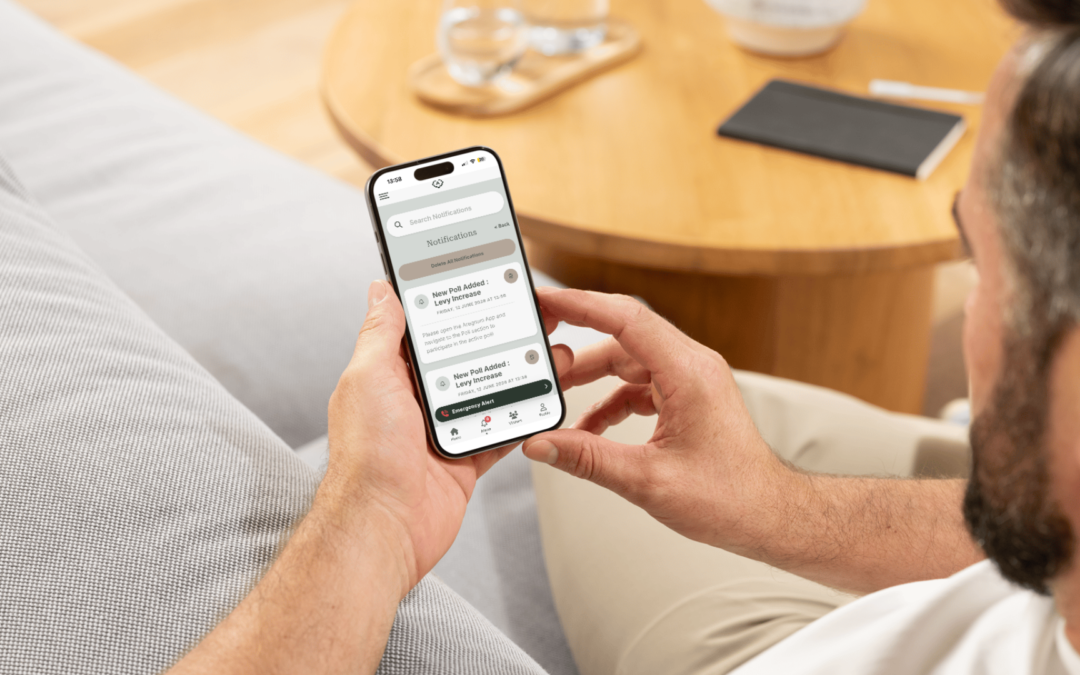
Aregnum gives apartment buildings a dedicated communication channel tied to verified resident records through the community app. When management sends a notice or an alert, it reaches residents through the app, linked to their actual resident profiles rather than to a self-selected chat or an ignored board. Because the same platform manages the building’s resident records, the communication audience stays in step with who actually lives in the building. A new resident is reachable from when they are onboarded, and a departed resident no longer receives building communication.
This reliability changes what communication can do for a building. Management can send important notices with confidence that they are reaching current residents on a channel meant for building matters, not competing with social chatter. Time-sensitive information, such as a planned water shut-off, an access issue or a security concern, can be communicated knowing it will land. The uncertainty that hangs over notice boards and group chats is replaced by a dependable channel, which is exactly what building communication needs to be useful.
Separating official communication from informal chatter is itself a significant benefit. A great deal of the friction in apartment buildings comes from official matters and personal disputes being tangled together in a single group chat. When management has a dedicated channel for building business, that business is communicated clearly and is not lost in or contaminated by social conflict. Residents can still chat among themselves wherever they like, but the building’s official communication is kept clear, professional and findable. This separation reduces conflict and makes both kinds of communication work better.
There is a record dimension that matters for smaller communities too. When building communication runs through the platform, there is a record of what was communicated and when. For a body corporate making decisions and informing residents of them, this record is valuable protection. If a resident later claims they were not informed of a decision or a hazard, the body corporate has evidence rather than relying on the recollection of a group chat. In small communities where disputes can become personal, this kind of clear record is genuinely useful.
The volunteer reality of most apartment buildings makes reliable communication especially valuable. Building communication usually falls to a body corporate member giving their time, who ends up moderating a fractious group chat in their spare time. A dedicated channel turns this into a manageable task: send the notice once, to the right audience, with a record kept. The volunteer is relieved of the thankless work of policing a group chat, and the building gets more consistent communication. For small communities running on volunteer effort, reducing this burden is a real benefit.
The group chat’s tendency to become a forum for conflict deserves particular attention, because it actively harms communities rather than merely failing to help them. A building group chat that starts as a practical tool often degenerates into a space where disputes between residents play out publicly, grievances are aired, and tempers flare, all visible to the whole building. This public conflict damages relationships among neighbours who have to live alongside one another, and it makes the chat a place residents come to dread rather than rely on. Worse, genuine building business gets caught up in the conflict, so an important notice can become the trigger for an argument. Separating official communication onto a dedicated channel removes building business from this toxic dynamic, which protects both the communication and the community’s relationships.
The drift of a group chat away from the actual resident list is a slower but equally damaging failure, and it mirrors the phantom credential problem in the communication domain. Over time, people leave the building but stay in the chat, new residents are not added, numbers change, and members mute or leave. The chat’s membership gradually ceases to correspond to the building’s actual residents, so a message to the chat reaches a drifting, inaccurate audience. Management cannot know whether it is reaching current residents or talking partly to former ones and missing new ones. A channel tied to verified resident records does not drift, because the audience is maintained as part of managing the building’s residents, so communication always reaches the current community rather than a historical artefact of who was once in the chat.
The record that a dedicated channel keeps is especially valuable in the close quarters of an apartment building, where disputes about what was communicated can be both common and bitter. In a small building, a claim that a resident was not informed of a decision, a rule, a levy change or a hazard can become a serious dispute, and without a record it comes down to one person’s word against another’s. A dedicated channel that keeps a record of what was communicated and when gives the body corporate a factual basis for such disputes, which can defuse them before they fester. In a community where people live close together and disputes are personal, having a clear record of official communication is a genuine protection for the volunteers running the building and for the harmony of the community.
It is worth acknowledging that residents value their informal community spaces, and a dedicated official channel is not meant to replace neighbourly chatter, which has its own value. Neighbours chatting, organising social events, and helping one another are part of what makes a building a community rather than just a set of flats, and that informal life should continue wherever residents like to conduct it. What a dedicated channel changes is only that the building’s official communication, the notices and alerts that matter for the building’s running and safety, is separated from the chatter and made reliable. The informal and the official each work better for being separated: the chatter is freed from the weight of official business, and the official communication is freed from the noise of the chatter.
In a building where people live in close proximity and depend on shared decisions, reliable communication is not a convenience but a necessity for the community to function at all. A dedicated, verified channel that reaches every resident, keeps official business clear of social noise, and maintains a record is the foundation that makes the rest of the building’s management possible, because almost everything else depends on residents being reliably informed. Getting communication right is therefore among the first things a building should attend to, since so much else rests upon it.
Apartment buildings need their residents to be informed, and the notice board and group chat do not reliably deliver that. A dedicated channel tied to verified resident records, as Aregnum provides, gives building management a dependable way to reach residents, keeps official communication clear of social noise, and produces a record that protects the body corporate. For small communities where reliable communication is essential and where the work usually falls to volunteers, this is one of the most immediately valuable things a management platform can offer.
Frequently Asked Questions
Why are notice boards and group chats unreliable?
A notice board only reaches residents who pass it and look, with no way to know who has read it. A group chat is noisy, buries important notices, drifts away from the actual resident list over time, and tangles official business with social conflict.
How does Aregnum communication reach residents reliably?
Notices and alerts reach residents through the community app, tied to their verified resident profiles, so the audience stays in step with who actually lives in the building, including new residents from when they are onboarded.
Does this replace residents’ own group chats?
No. Residents can still chat among themselves wherever they like. What changes is that the building’s official communication runs through a dedicated, reliable channel rather than being lost in or contaminated by social chatter.
Is there a record of building communication?
Yes. Communicating through the platform keeps a record of what was sent and when, which protects the body corporate if a resident later claims they were not informed of a decision or hazard.
See Aregnum in action
Ready to turn your community into an effortless, secure haven?